
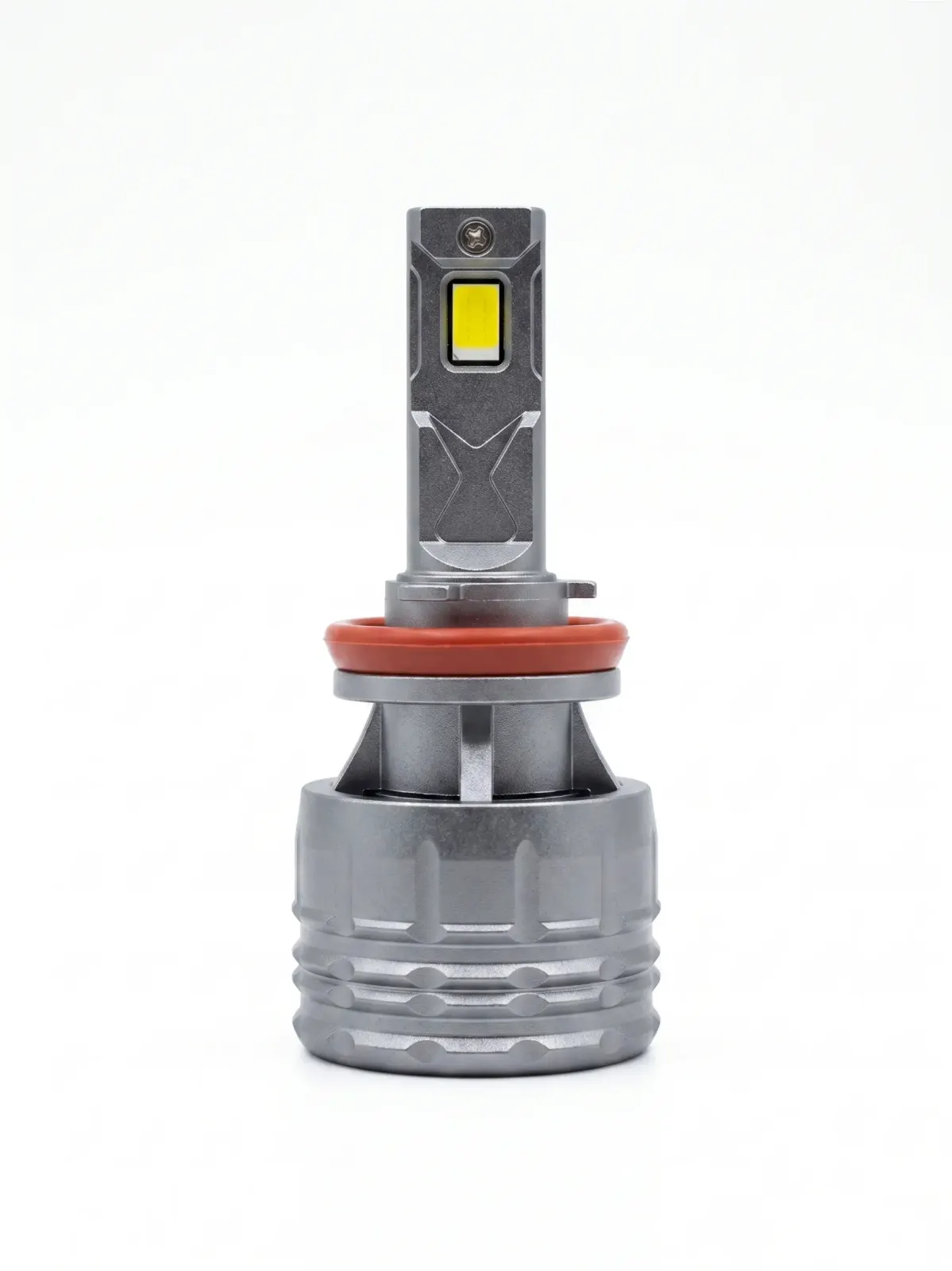
Real lumens are measured with an integrating sphere — any other number on the box is marketing. For the Mexican market: serious 70–100W H11/9005 bulbs deliver 8,000–13,000 real lumens per pair; 6000K dominates local taste, with 5000K gaining ground in rainy/foggy regions for better penetration. Ask the factory for the measurement report of the exact model and validate the beam cut-off pattern on a real car before approving production.
| Test | Correct equipment | What it tells you |
|---|---|---|
| Luminous flux | Integrating sphere | The only lumen number that counts |
| Color temperature (CCT) | CCT meter / spectrometer | Pair consistency, not just the nominal K |
| Beam pattern | Test wall / real car | Clean cut-off vs glare — decides sellability |
| Operating temperature | Thermal camera | Bulb base >90°C is a bad sign |
6000K or 5000K for Mexico?
6000K is the aftermarket standard (cool white, premium look); 5000K wins in rainy/foggy regions. Many wholesalers stock both and let the installer recommend.
Are the '360,000 lumens' on cheap boxes real?
No. Marketing. A halogen pair does 1,500–2,000 real lumens; a serious 70–100W LED delivers 8,000–13,000 per pair. Absurd box numbers signal a seller who measures with imagination.
Can I test without a lab in Mexico?
Comparative yes: against a new halogen and a known brand, fixed camera, same wall distance. Absolute lumens need an integrating sphere — hence factory report + paid sample.
Shop LED headlight bulbs by size
Wholesale buyers order by socket, not by series code. Pick a base to see the Chedina models listed for it, with specs and a quote path — and confirm the exact base before ordering.
Related reading
Short answers to the questions buyers ask us most.