
You installed a set of LED headlight bulbs. They light up. Then the dashboard lights up too — a bulb-out warning, a flicker every few seconds, or a message saying the lamp is defective. The bulbs are fine. Your car is just confused. This guide explains what is happening and how to make the error disappear without guessing. Chedina manufactures the CANbus error-free LED headlight range covered in this guide. See the verified model list below for each bulb's full specification, with a direct link to every product page.
What CANbus Actually Checks (and Why It Flags LEDs)
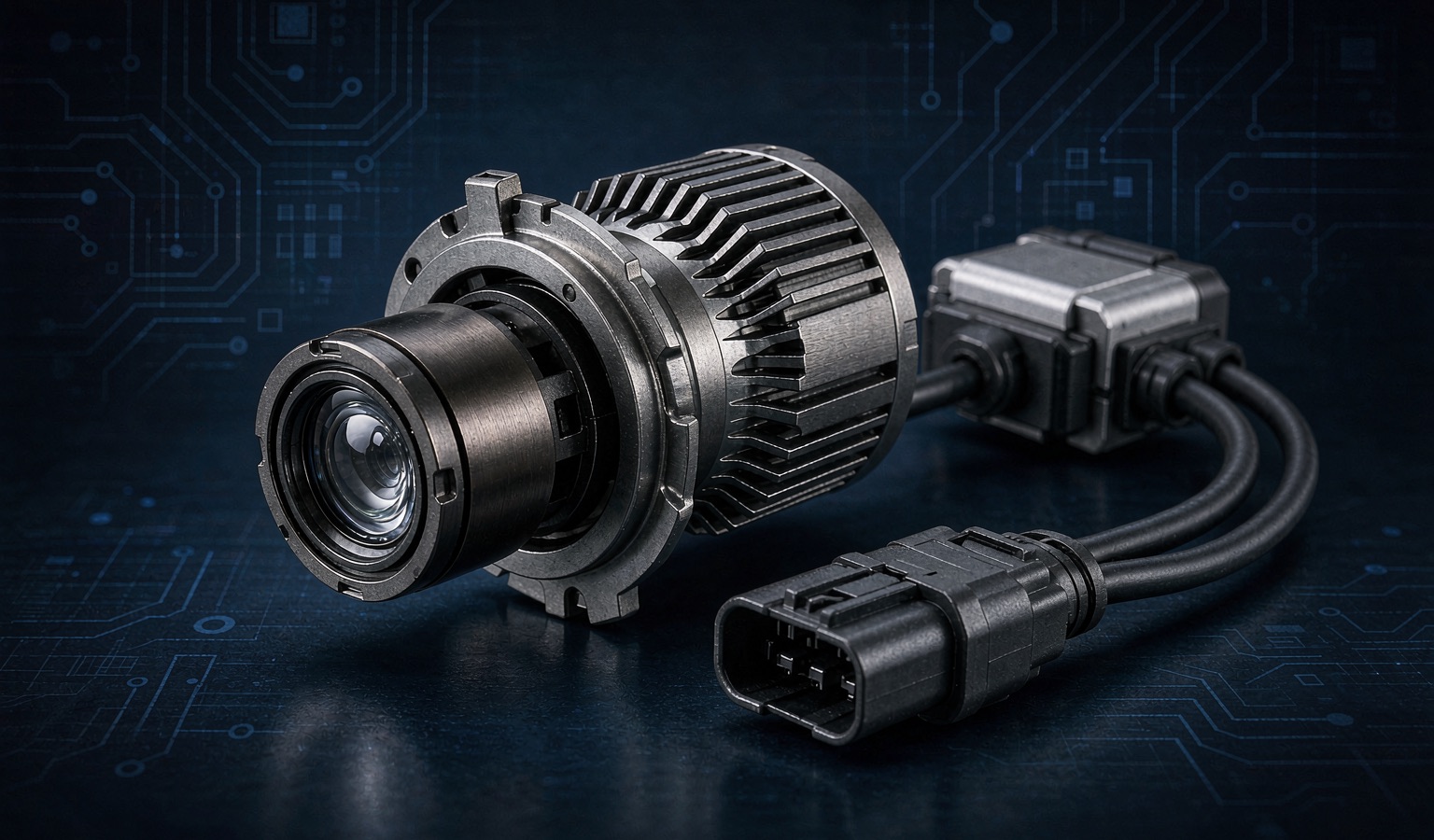
CANbus is the digital network most cars built after ~2005 use to talk between modules — lights, doors, ABS, the lot. One job of that network is bulb monitoring: the body control module watches how much current each lamp draws. A halogen bulb pulls roughly 55 W on a 12 V system, about 4.5 A. When a lamp burns out, that current drops to near zero, and the module lights a warning so you are not driving with a dead headlight.
An LED bulb that makes the same light pulls 15–25 W instead of 55 W. To the monitoring module, a 20 W LED looks almost exactly like a burnt-out halogen: low current, so it assumes the bulb is dead and throws the error. The bulbs are working perfectly. The car is measuring the wrong thing.
CANbus monitoring only runs on lighting circuits that the car actively supervises. If your vehicle is older than ~2005, or the circuit is not monitored, you may never see an error at all — even with basic LEDs.
The Four Symptoms You Will Actually See
- Dashboard bulb-out warning that stays on even though both bulbs are lit.
- Flickering or pulsing light, usually a few times per second, at idle or with the engine off.
- One side works, the other side goes dark intermittently — the module is cutting power to 'protect' the circuit.
- A 'lamp defective' or 'check lighting' message on the dashboard or infotainment screen.
Why LEDs Trip the Monitor: The Load Gap
The table below is the whole problem in one view. The module expects a halogen load; an LED leaves a hole where that load used to be.
| Bulb type | Typical wattage | Current draw (12 V) | What the monitor sees |
|---|---|---|---|
| Halogen H7 | 55 W | ~4.6 A | Normal — no warning |
| LED H7 (standard) | 18–25 W | ~1.5–2.1 A | Looks like a burnt-out bulb |
| LED H7 (error-free) | 18–25 W + load circuit | ~4.5 A equivalent | Reads as a healthy bulb |
Error-Free vs Canbus-Ready vs Decoder — Know the Difference
These three terms get used interchangeably and they are not the same thing. Buying the wrong one is the most common reason the error comes back.
| Term | What it is | When you need it |
|---|---|---|
| Error-free bulb | LED with a built-in load resistor or capacitor that fakes the halogen current draw. | Mild monitoring (VW, Audi, some GM) where a small extra load silences the warning. |
| Canbus-ready bulb | Marketing term — usually an error-free bulb with a slightly higher draw. Read the spec, not the label. | Same as error-free; verify the real wattage before trusting it. |
| External decoder / canceller | A separate resistor or capacitor harness you add at the socket. | Aggressive monitoring (many BMW, Mercedes, newer VAG, some CAN-equipped trucks) that ignores in-bulb loads. |
A resistor decoder gets hot — that is what a halogen's wasted energy used to do. Mount it away from plastic, wiring looms, and the headlight housing seal. Cheap decoders with no housing melt. Use a can-style or finned aluminium decoder, not a bare ceramic block taped to the loom.
How to Fix CANbus Errors: A Step-by-Step Fix
- Confirm it is CANbus. Remove one LED and reinstall the halogen; if the warning disappears, it is a load/monitoring issue, not a wiring fault.
- Try a proper error-free LED first. On lightly monitored cars this alone clears the warning and needs no extra parts.
- If the warning stays, add an external decoder at the socket. One decoder per affected circuit (often per side).
- Pick the right decoder: a capacitor type silences flicker on sensitive modules; a resistor type is needed when the module measures true wattage. When in doubt, resistor wins.
- Rule out non-CANbus causes. A dim or dead side can also be reversed polarity, a loose connector, or a grounded housing — check those before blaming CANbus.
If one side flickers and the other does not, the car is often monitoring per-side. Fit decoders on BOTH sides even if only one complains — imbalance causes the good side to be flagged next.
Choosing Error-Free Bulbs by Socket
| Socket | Common on | Notes |
|---|---|---|
| H4 / HB2 | Older European & Asian cars, many motorcycles | Hi/lo in one base — pick an error-free H4 with a stable hi-lo beam. |
| H7 | VW, Audi, Mercedes, Peugeot, many 2000s+ cars | Highly monitored — decoders are common on German cars. |
| H11 / H8 / H9 | Toyota, Honda, Subaru, Hyundai, fog lights | Usually mild; error-free bulbs often enough. |
| 9005 / HB3, 9006 / HB4 | US & Japanese trucks, SUVs, fog lights | Pickups (RAM, Silverado, F-series) often need decoders. |
Not sure of your socket? Our LED headlight category lists the base type and monitored-fit notes per product, and our OEM/ODM team supplies error-free and decoder-bundled kits by the container.
Common Mistakes That Keep the Error On
- Trusting the 'canbus-ready' sticker without checking real wattage — the label is not a spec sheet.
- Adding a decoder only to the side that complains, then watching the other side fail a week later.
- Taping a bare resistor to the wiring loom, where the heat cooks the insulation.
- Buying the cheapest kit, where the 'error-free' circuit is a weak capacitor that drifts with temperature.
- Blaming the bulb when the real fault is reversed polarity or a bad connector.
Do You Need Error-Free Bulbs for Your Market?
Monitoring strictness is regional and model-specific, not country-wide. European VAG and Mercedes cars are the most aggressive; many US trucks monitor too. The legal side — road approval, ECE vs DOT — is a separate question we cover in our DOT vs ECE guide. Error-free only fixes the dashboard warning; it does not change whether the beam pattern is road-legal where you are.
Chedina CANbus Error-Free LED Bulbs (Verified Models)
Chedina's published product specifications list the bulbs below as CANbus error-free — the in-bulb load circuit is specified to keep the bulb-out warning silent on monitored vehicles. The C12 additionally carries a built-in intelligent CANbus driver. Fit still depends on your exact car's monitoring level; if a warning persists after fitting, add the external decoder from the fix steps above.
| Model | Power | Lumens | CANbus note | Spec sheet |
|---|---|---|---|---|
| C12 | 170 W | 20000 LM | Built-in intelligent CANbus driver (error-free) | View C12 |
| C20 | 110 W | 20000 LM | Listed CANbus error-free | View C20 |
| C24 | 110 W | 25000 LM | Listed CANbus error-free | View C24 |
| T17 | 80 W | 12000 LM | Listed CANbus error-free | View T17 |
| C19 | 60 W | 12000 LM | Listed CANbus error-free | View C19 |
| T18 | 130 W | 18000 LM | Listed CANbus error-free | View T18 |
These six are the highest-demand fitments. Chedina lists 14 bulbs with the CANbus error-free specification in total, across universal H1/H4/H7/H11/9005/9006 bases. Browse the full LED headlight category to filter by socket and confirm the CANBUS field on each product.
Frequently Asked Questions
What does 'CANbus error-free' actually mean?
It means the LED bulb includes a load circuit (resistor or capacitor) that draws roughly the same current as the halogen it replaces, so the car's bulb-monitoring module reads it as a healthy lamp and stays silent. The light output is still LED; only the measured load is faked.
Will error-free LED bulbs work on a car that has no CANbus?
Yes. On a car without bulb monitoring, an error-free bulb just behaves like a normal LED — the extra load circuit sits there doing nothing harmful. There is no downside to using them on unmonitored vehicles.
Why do my LED headlights flicker even with error-free bulbs?
Flicker means the module is pulsing the circuit to 'test' the load and the in-bulb capacitor is too small to hold it steady. The fix is an external capacitor or resistor decoder at the socket. Flicker is almost always a CANbus test pulse, not a faulty bulb.
Do I need a decoder or just a resistor?
A resistor decoder fakes true wattage and works on the strictest modules. A capacitor decoder silences test-pulse flicker on sensitive but lightly monitored cars. If the warning persists after error-free bulbs, go straight to a resistor decoder.
Are error-free LED headlights road legal?
Error-free only removes the dashboard warning. Road legality depends on beam pattern and approval marks (ECE in most of the world, DOT in the US, with regional variants). See our regulations guide for the per-market rules.
Which sockets need decoders most often?
H7 on German cars (VW, Audi, Mercedes) and 9005/9006 on US pickups (RAM, Silverado, F-series) are the most common decoder cases. H11/H8/H9 on Asian cars usually accept error-free bulbs without extra parts.
Which Chedina LED bulbs are CANbus error-free?
Chedina's product specifications list 14 bulbs as CANbus error-free — including the C12 (170 W, with a built-in intelligent CANbus driver), C20, C24, T17, C19 and T18. They cover universal H7/H11/9005/9006 bases. See the verified model table above, or browse the full LED headlight category and check each product's specification for the CANBUS field.
Shop LED headlight bulbs by size
Wholesale buyers order by socket, not by series code. Pick a base to see the Chedina models listed for it, with specs and a quote path — and confirm the exact base before ordering.
Related reading
Short answers to the questions buyers ask us most.