
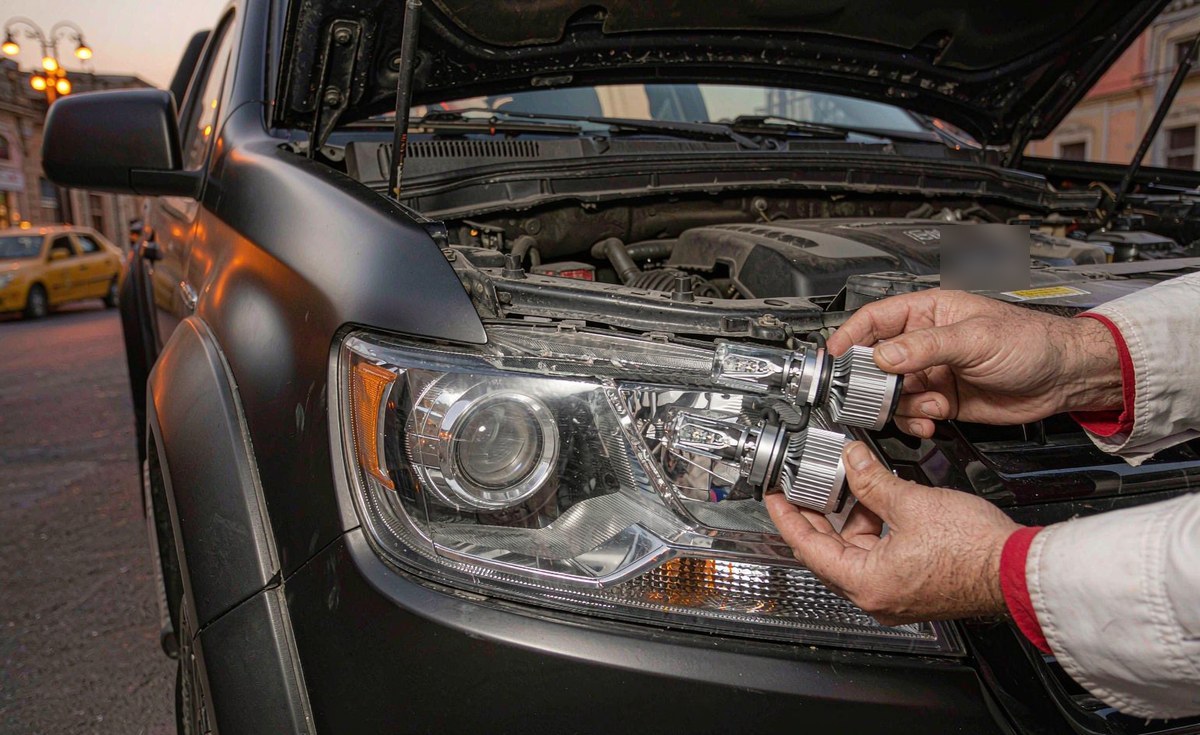
Buying LED bulbs in Mexico is easy; buying the right ones is not. The difference between an upgrade that looks good and one that glares at everyone is almost never the price — it is the size, the chip position and the room to shed heat. This guide goes in that order, with what you can actually verify before paying and what no seller can promise you.
1. The size decides everything (and is never a guess)
Before lumens or colour, confirm the socket: H4, H7, H11, 9005, 9006, 9012. A bulb of the wrong size cannot be 'adapted': if it does not seat, it does not seal, and if you force it the filament sits out of focus. How to confirm it is in our guide to finding the bulb your car uses: the code on the old bulb, the marking on the lens, and the manual by year and trim. On an imported car, trust the headlight rather than the spec sheet.
2. Colour: 4300K, 6000K and the blue you should skip
Colour temperature does not measure how much light there is, it measures what colour it looks. A 6000K does not light more than a 4300K; it lights differently. In rain, fog or wet asphalt — three things Mexico gets plenty of from June to October — very white or bluish light scatters in the water and returns less contrast further down the road. For mixed city and highway use, 4300K–5000K usually beats the fashionable 6500K.
| Temperature | How it looks | Where it works best | What you give up |
|---|---|---|---|
| 3000K | Yellow | Fog lamps, heavy rain, fog | Short reach on the open road |
| 4300K | Warm white | Mixed use, rain, wet asphalt | Looks less 'modern' than cool white |
| 6000K | Cool white | City and dry highway, the best seller | More glare back at you in fog |
| 6500K or higher | Bluish | Looks | Worse contrast when wet, more likely to be flagged in an inspection |
3. Chip, heatsink and cap: what decides whether it lasts
An LED only works if the chip sits exactly where the halogen filament was. A few millimetres forward or back and the reflector throws the light at a different height: it lights the trees instead of the road, or it glares at oncoming traffic. More lumens do not fix that. The second factor is heat: LEDs lose life quickly above a certain temperature, and in a lamp with a sealed rear cap the heatsink has nowhere to dump it. Before buying, look at the space behind the bulb: if a finned heatsink or a fan will not fit, that LED will last months, not years.
4. Inspections and rules: what you can be stopped for
Traffic rules and inspection criteria vary by state and municipality, so there is no single national answer. What is checked in practice: both lamps working, no blue or red colour, no glare, and a beam that is not aimed high. No seller can hand you a 'legal light certificate' valid across Mexico; what you can ask for is a datasheet, a written warranty and an invoice, and keep the original bulb size in case you need to switch back. The approval framework (DOT vs ECE) is covered in our DOT vs ECE guide.
5. Warning signs of a cheap LED bulb
- The box promises impossible numbers ('80,000 lm' per bulb): a factory halogen is around 1,000–1,500 lm.
- They will not say which chip it uses or at what temperature it was tested.
- The heatsink is a thin plate without fins, or the fan spins without a bearing and whines.
- No decoder included, so the car reports 'bulb out' from day one.
- No written warranty and no address, just a WhatsApp number.
- The packaging omits socket, voltage and polarity.
6. Fitting: two details that change the result
First, orientation: on most sockets the chip must sit at the sides (3 and 9 o'clock), not top and bottom. Second, sealing: if closing the cap deforms the heatsink or lets the connector through, moisture gets in and the lamp fogs up in the first rain. Reuse the rubber ring if the lamp has one. Test at night against a wall 5 metres away: the cut-off line should be horizontal and below the eyes of a car coming the other way.
7. Buying in volume for a workshop or shop
For resale, profitability is decided not by the FOB price but by the return rate: ask for a paid sample, measure lumens with a lux meter instead of trusting the box, and require a one-year written warranty. Typical MOQ per bulb model starts at 500–1,000 pieces, and private label is defined by logo and packaging. Import details are in our guides to importing LED headlights from China to Mexico and MOQ and private label.
Are LED bulbs legal in Mexico?
It depends on the traffic rules of your state or municipality and on how the light ends up in the lamp. There is no universal 'approved LED' for the whole country: what is checked in practice is colour, beam height and glare. If you are buying in volume, confirm the local criteria before importing, and keep the datasheet and invoice.
How many lumens do I need?
A typical halogen makes 1,000–1,500 lumens. LED kits advertise 3,000–6,000, but what reaches the road is limited by the housing: in a reflector, the excess goes upward and glares. A moderate, well-positioned LED puts more usable light down the road than a high number that is badly aligned.
Does 6000K look better than 4300K?
It looks whiter, which is not the same as seeing further. 6000K feels modern in the city and in dry weather; 4300K keeps more contrast in rain and on wet asphalt. If you drive at night on the open road, 4300K–5000K is usually the better call.
Do I need a CANbus decoder?
Only if the car has a bulb-out warning or a resistance check. Without a decoder the LED lights up but the dash reports an error, or the bulb flickers. Ask for it included rather than buying it separately: generic decoders do not always match the resistance of the original bulb.
How long do LED bulbs last?
With adequate heat dissipation, 20,000–30,000 hours; in a sealed lamp with no room to shed heat, many fail within 6–12 months. The most common cause of early death is not the chip but trapped heat and moisture entering through a poorly closed cap.
Shop LED headlight bulbs by size
Wholesale buyers order by socket, not by series code. Pick a base to see the Chedina models listed for it, with specs and a quote path — and confirm the exact base before ordering.
Related reading
Short answers to the questions buyers ask us most.